1834-08-01 Slavery Abolition Act in the British Empire/Canada
The Slavery Abolition Act, passed by the British Parliament in 1833, came into force on August 1, 1834. In fact, the Act liberated less than 50 enslaved Africans in British North America. For most enslaved people in Canada, the Act resulted only in partial liberation, only emancipated children under the age of six, and obliged others to be retained for four to six years as apprentices. The Act did initiate the formal end to slavery, and since 2021 Emancipation Day has been commemorated annually in Canada on August 1. Emancipation Day in Canada: Past, Present, and Future [caption id="attachment_3988" align="aligncenter" width="1024"] Permanent Memorial to Honour the Victims of Slavery and the Transatlantic Slave Trade at the United Nations. ©United Nations. This Permanent Memorial was unveiled on 25 March 2015 to mark the International Day of Remembrance of the Victims of Slavery and the Transatlantic Slave Trade; located on the United Nations Visitors Plaza in New York, the memorial invites people everywhere to contemplate the legacy of the slave trade and to fight against racism and prejudice today.[/caption] Emancipation and abolition of slavery became law in the U.S. through the 13th Amendment to the Constitution after it was ratified by 2/3 of the states on December 6, 1865.
March 11, 1850: Vancouver Island becomes a Colony
The Imperial Government of the Crown Colony of Vancouver Island was created on March 11, 1850. Richard Blanshard, a 32 year-old barrister from a wealthy British family, formally assumed office as Governor of the Colony of Vancouver Island.
1851-1864: James Douglas is Governor of Vancouver Island (1851–64) and British Columbia (1858–64)
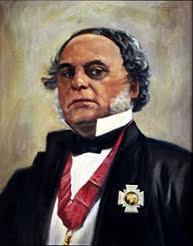
James Douglas was born in Guyana in 1803. His father was Scottish and his mother was “free coloured.” Douglas was Chief Factor for the Hudson's Bay Company operating from Fort Victoria. In 1851 he was appointed Governor of the Crown Colony of Vancouver Island, succeeding Richard Blanshard. Meanwhile, the mainland colony functioned under the defacto administration of the Hudson’s Bay Company with Douglas as its chief executive. In 1858, the mainland colony became the Colony of British Columbia, and Douglas was named as its governor. He concurrently continued as Governor of Vancouver Island, which remained a separate colony until 1866. Queen Victoria knighted Douglas in 1863. Read more
1851 – 1898: The BC gold rush period lasted for about 50 years
Here are the dates and places of important gold finds in BC. The 1858 Fraser River Gold Rush, 1859 Cariboo Gold Rush and the 1864 Leech River Gold Rush are the most significant in BC Black history. 1851 Haida Gwaii Gold Rush 1858 Fraser River Gold Rush* 1859 Cariboo Gold Rush* 1864 Leech River (Vancouver Island) Gold Rush* 1865 Big Bend Gold Rush 1873 Cassiar Gold Rush 1885 Granite Creek Gold Rush 1898 Atlin Gold Rush
April 14 1858: Douglas’s “emissary” Captain Jeremiah Nagle meets with the San Francisco Black community
On April 14, 1858, as the Black community were celebrating the release of fugitive slave Archy Lee at the African Methodist Episcopal Zion Church in San Francisco, Jeremiah Nagle, captain of the steamship Commodore, arrived at the meeting. It is reported that Nagle came well-prepared to the meeting with maps of Vancouver Island and a letter from “a gentleman in the service of the Hudson’s Bay Company of undoubted veracity” inviting the Black community to come to the Colony of Vancouver Island and giving details about the colony. The Pioneer Committee arrived in Victoria on April 25, 1858.
April 25, 1858: The Pioneer Committee from San Francisco arrives in Victoria
On April 25th,1858 the Steamship Commodore sailed into Victoria harbour from San Francisco. In addition to 450 gold seekers, 35 Black people were on board - the Pioneer Committee to consult with Governor Douglas. A delegation of three that met with Douglas: Fortune Richard, Wellington Delaney Moses and Mr. Mercier. This plaque installed at the harbour by the City of Victoria on August 18, 1978 reads, “In commemoration of the arrival in 1858 of the first group of Black settlers to the Colony of Vancouver Island.”
The Colony of British Columbia is established on August 2, 1858
The Colony of British Columbia, named by Queen Victoria, with New Westminster as its capital, is the area today known as “the mainland”. It was a separate entity from the Colony of Vancouver Island. Accounts relate that James Douglas agreed to sever his ties to the Hudson’s Bay Company to become governor of both the Colony of Vancouver Island and the Colony of British Columbia.
52 Black men apply for citizenship
In September 1858, the Victoria Gazette reported on the application of 52 Black men for British citizenship. Their occupations were Baker, Barber, Blacksmith, Carman, Carpenter, Carrier, Contractor, Cook, Cooper, Drayman, Farmer, Fruiterer, Gardener, Grocer, Hairdresser, Laundryman, Merchant, Messenger, Miner, Painter, Plasterer, Porter, Restaurant keeper, Saloon keeper, Ships carpenter, Ships caulker, Storekeeper, Tailor, Teamster, and Water carrier.
Settlement on Salt Spring Island begins in the summer of 1859
Pre-emption was the legal method of acquiring Crown land that had not been fully surveyed by claiming and improving it for settlement and agricultural purposes. The first Black pre-empters on Salt Spring from California arrived in the summer of 1859. They included E.A. Booth, Armstead Buckner, William Isaacs, and Fielding Spotts. Black settlers later in that same year included Abraham Copeland, Levi Davis, W.L. Harrison, the Jones brothers (John Craven, William Allen, and Elias), William Robinson, and Hiram Whims. Daniel Fredison, a Black man from Hawaii, also settled on the island. Salt Spring Island Archives has mapped 26 Black homesteads
John Craven Jones is the first Black teacher in BC and the only teacher on Salt Spring Island
John Craven Jones graduated from Oberlin College in 1856 and taught for two years in a one-room school for Black students in Xenia, Ohio. When he moved to Salt Spring Island in 1859, he pre-empted 100 acres for his home; and with the support of the community, he resumed teaching. John taught a total of 25 students in two schools until about 1875, one in Vesuvius and one in Fernwood. The first schools were in rough buildings, hardly more than sheds. In 1869 when public funding began, Jones’ salary was $40.00 per month. Read more
The Religious Feud and the “Negro’s Corner”
The Daily Colonist reported on a “difference of opinion” between Rev. W.F. Clarke and Rev. M. MacFie, both missionaries sent to Victoria from England by the Congregational Missionary Society, "Mr. Clark holds that Christianity knows no difference between the white and colored man; and therefore he will not suit the prejudices of anyone by creating a 'negro’s corner' in his church. As a matter of 'taste' Mr. MacFie prefers separating them.” The Colonial Missionary Society settled the issue on August 14,1860 by passing a resolution holding, “That this committee never have sanctioned and never will sanction in Churches wholly or in part sustained by the funds of the Colonial Missionary Society, the compulsory separation, in places of worship, of the colored races from the white population.”
1860-1864 Victoria Pioneer Rifle Corps
By the spring of 1860, 40 to 50 Black men had enrolled in the Victoria Pioneer Rifle Corps and in July 1861 were officially sworn in. The Royal Navy supplied drill sergeants and the Corps financed and built a drill house. The Victoria Pioneer Rifle Corps is considered the first British or Canadian military unit formed west of Ontario. [caption id="attachment_5696" align="aligncenter" width="1000"] About 20 members of the Victoria Pioneer Rifles Corps stand in their ranks with the British flag in the background. A brass band formed part of the unit: a few musicians can be seen on the left. Written in the bottom border “Victoria Pioneer Rifle Corps. Also known as Sir James Douglas Colored Regiment” Image F-00641. Courtesy of Royal BC Museum and Archives[/caption] Read more
“First Victoria Directory” includes 27 Black citizens
The “First Victoria Directory” was originally published in March 1860. It is "comprised of a general directory of citizens, also, an Officials list, list of voters, postal arrangements and notices of trades and professions; preceded by a preface and synopsis of the commercial progress of the colonies of Vancouver Island and British Columbia. Illustrated” From the recognized names, an estimated 27 Black men were listed as citizens. Moses Rowe Smith, who immigrated to Victoria from Ontario, appears to be the only Black man on the list of voters. [caption id="attachment_6165" align="aligncenter" width="401"] Advertisement for Edwards & Fox, Barbers on page 40.[/caption]
On British Soil He was Free: The case of Charles Mitchell
Charles Mitchell, enslaved since boyhood, was a stowaway aboard the SS Eliza Anderson sailing from Olympia Washington to Victoria. When the steamer arrived in Victoria word soon spread that a slave was being detained on board. The Royal BC Museum and Archives documented that “As many as 700 people gathered dockside on September 25th, 1860 calling for his release.” The case was taken immediately to the BC Supreme Court where Charles Mitchell was declared a free man because he was on British soil. Watch the video produced by the Royal BC Museum in a series "This Week in History: Charles Mitchell, from slavery to freedom.
April 12, 1861 the American Civil War begins
On April 12, 1861 President Abraham Lincoln declared war between the Union and Confederate states. An estimated four million enslaved people in 15 states and territories were “owned” by 52,128 slaveholders. There were also an estimated 400,000 free African Americans. The war is considered to have ended on April 9, 1865, when Confederate General Robert E. Lee surrendered to Union General Ulysses S. Grant. [caption id="attachment_9610" align="aligncenter" width="750"] American Civil War Soldiers, Company I of the 36th Colored Regiment[/caption]
Victoria, BC: Black patrons only permitted in theatre gallery seating
While reported incidents of discrimination in Victoria’s theatres date back to 1860, the most noted incident happened on September 25, 1861 when Mifflin and Maria Gibbs, family friend Nathan Pointer and Pointer’s daughter attended a hospital benefit at the Victoria Theatre. Both families were seated in the dress circle. At the start of the concert one of the performers, Emil Sutro, refused to go on stage unless the Black patrons were removed from the dress circle. Gibbs refused to move, Sutro left, and the concert went ahead. Then, at the end of the performance the Gibbs and Pointers were doused with flour from the balcony. A melee broke out and charges were filed against all involved. At the trial the judge acquitted the four white persons charged in the incident. Gibbs admitted assaulting one man and was fined five pounds. The charge of assault against Nathan Pointer was dropped for lack of evidence. Theatres began publicly stating Black patrons could only be seated in the gallery. The newspapers received numerous letters both supporting and condemning the Black community. Black residents petitioned both Douglas and his successor on Vancouver Island, Arthur Kennedy to end the discrimination, but no remedy was made.
Jacob Francis is nominated for the Legislative Assembly
Four candidates contended for two vacant Legislative Assembly seats in Victoria in an 1861 by-election. Joseph Trutch came in second in voting and Jacob Francis was third. There was public debate and support for Francis’s claim to the seat, in that Trutch was absent from the colony when the election was called and could not take the required oath of allegiance. Francis’s petition failed, and Trutch’s election stood.
Dandridge House is constructed
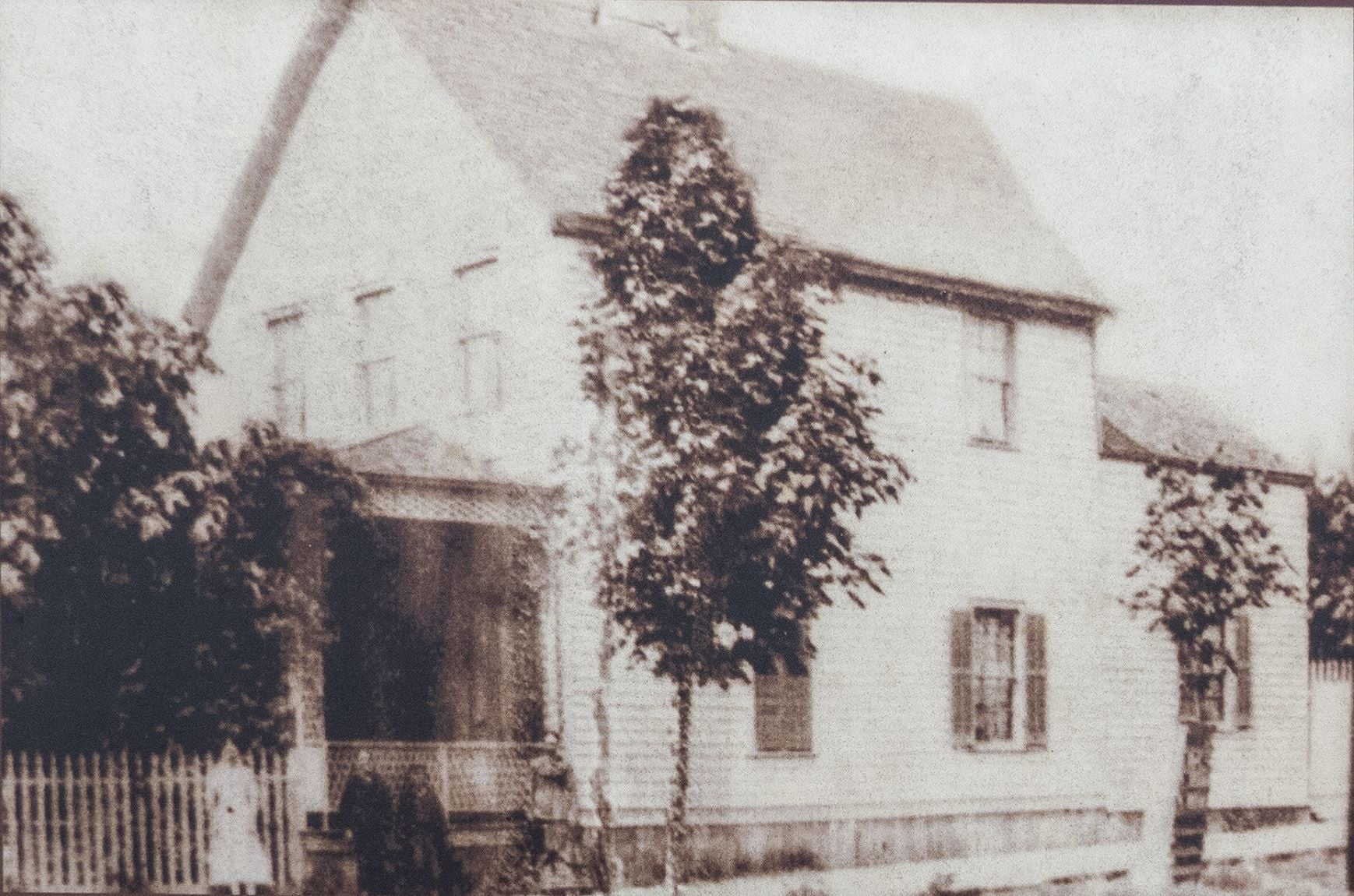
John and Charlotte Dandridge arrived in Victoria in 1858. John was one of the men who applied for citizenship in 1858. In 1860 they were joined by their daughter Sydna, her husband Abner Hunt Francis and their grand-daughter Theodosia, age about 16. The house was built with most of the financing from Abner. It's original location was on Johnson Street; and it was moved to Rudlin Street around 1897-98. Following a major restoration project, the home received heritage designation in 2003. More about "The House That John Built" and what the current owners have to say. Image: Dandrige House, circa 1872, courtesy of current owners
“Shall a Coloured Man Drink in a White Man’s bar?”
Jacob Francis fought discrimination by suing two bar owners for refusing to serve him. While he was not successful against the first barkeeper in April 1860, in July 1862 he achieved a favorable outcome against the second barkeeper. The magistrate ruled that any barkeeper refusing service to Black men would not be given a license or would be find five pounds sterling and their licence would not be renewed.
John Giscome and Henry McDame: Northern B.C. Exploration
In the fall of 1862 John Robert Giscome and Henry McDame embarked on their one year, 60 km trek to explore northern BC and northern parts of what is today the provinces of Alberta and Saskatchewan. As early as 1874 one of the creeks they discovered became known as McDame Creek. This name was officially adopted in the First Report of the Geographic Board of Canada, 1898, as a well-established local name. The Giscome Portage Trail, designated as an official Heritage Site on July 17, 1997, commemorates their trek. The Indigenous name of the trail is Lhdesti or “the shortcut” and was long used by the Lheidli T’enneh First Nations as one of their trade routes. Image Courtesy of Kevin Creamore, Prince George
January 1, 1863: Emancipation Proclamation in the United States
The Emancipation Proclamation issued by U.S. President Abraham Lincoln the previous September came into effect on January 1,1863. However it did not abolish slavery. The Proclamation declared free all enslaved people in the Confederate States who resided in territory still in rebellion against the United States. As the Union Army captured more Confederate territory it would also liberate enslaved people living in that territory. Emancipation and abolition of slavery only became law in the U.S. through the 13th Amendment to the Constitution after it was ratified by 2/3 of the states on December 6, 1865.
July 1, 1863: Business tax assessment for 22 Black businesses
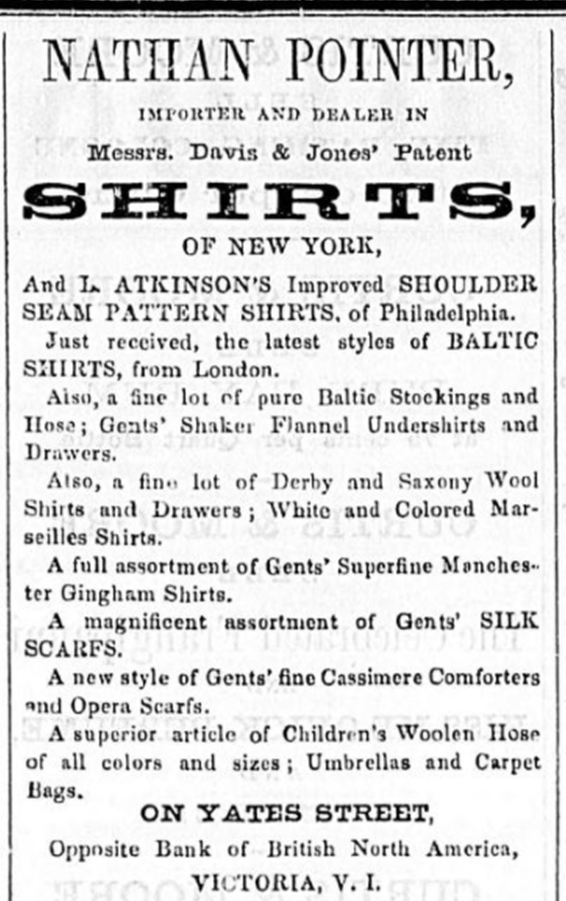
The Government Gazette lists "Persons liable to pay taxes under the provision of the 'Trade Licenses Amendment Act, 1862' for the half-year commencing July 1, 1863.” 22 Black businesses have been recognized as included in the listing. Thomas Whiting Pierre’s tailoring business was assessed $300. His son John Thomas Pierre took over the business circa 1890 when he was 27. Nathan Pointer's clothing store had the highest assessment of the Black businesses at $2,600.00. Entrepreneurs, businesses, shops, and services
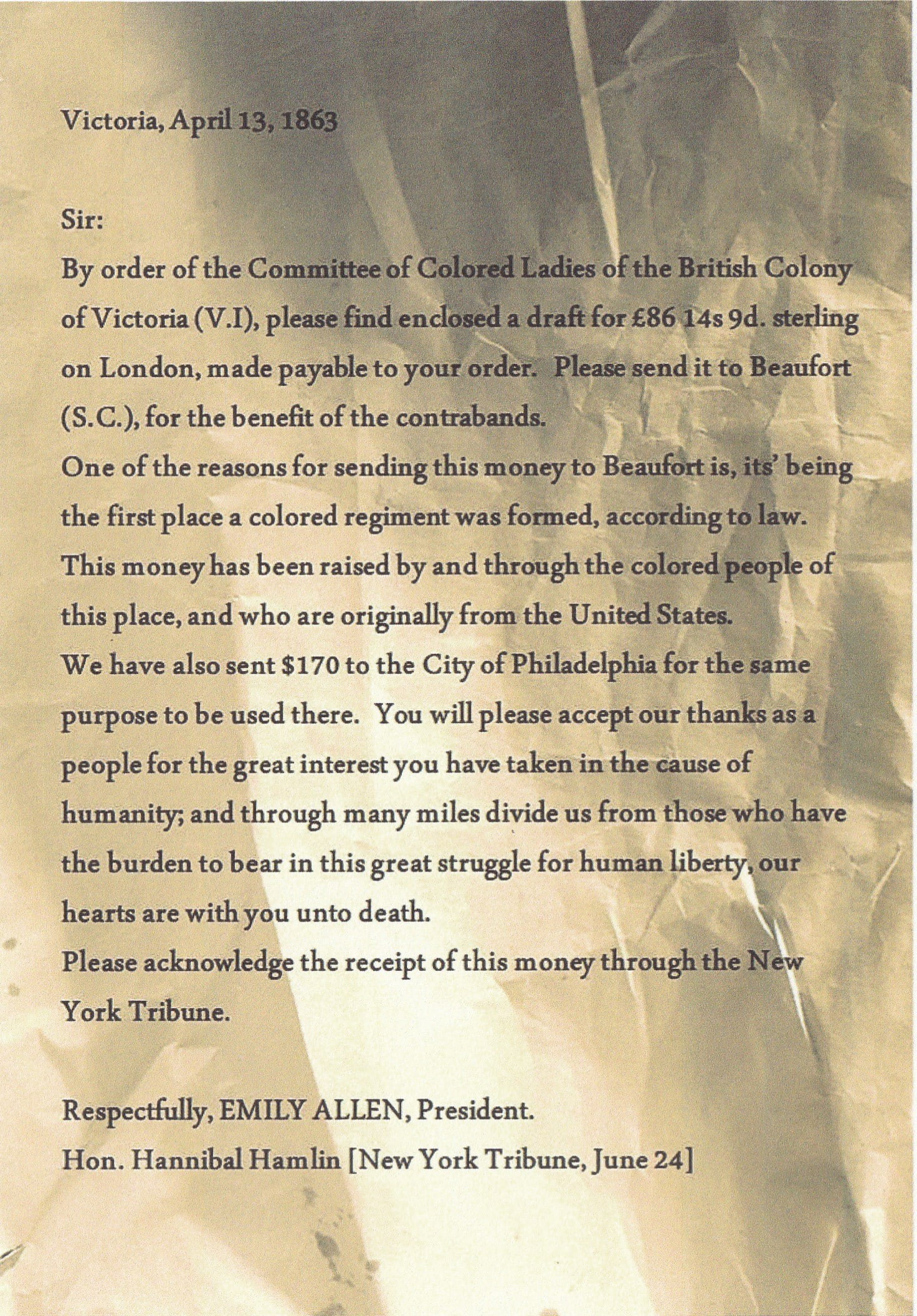
Committee of Colored Ladies of the British Colony of Victoria (V.I.) support “the Contrabands”
The Black soldiers who supported the Union in the American Civil War were known as “the Contrabands.” The Fugitive Slave Act, which deemed people held as slaves as “property” to be returned to their owners, had been the law in effect prior to the commencement of the Civil War. The Confiscation Act of 1861 was passed in the U.S. to overrule the former law. The Confiscation Act was effectively used to ensure that Black soldiers fighting on the side of the northern army would not be returned to slave holders. The letter from the Committee expressed that "..though many miles divide us from those who have the burden to bear in this great struggle for human liberty, our hearts are with you unto death." Read the letter
August 1864: Gold is discovered at Leech River on Vancouver Island
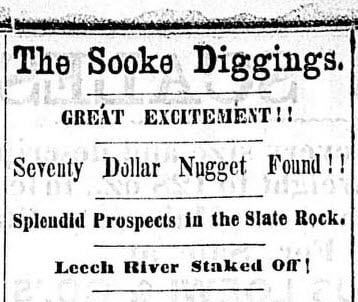
In the summer of 1864, four Black men, Samuel Booth, George Munro, John Tyril and William Dyer discovered gold on the Leech River in Sooke, about 40 miles west of Victoria. On August 4, 1864 the local newspaper reported on the high purity of the specimen found. It was worth $73.20 (about $2,500.00 in 2020 Canadian dollars). The four men formed the Industry Company. Unlike the distant Fraser and Caribou gold finds, prospectors could travel from Victoria overland by trail or by steamer within a day. Stores, hotels and other mining-related businesses were quickly established but within 18 months were abandoned.
1864: Victoria Pioneer Rifle Corps disbands
On May 30, 1864 the Victoria Pioneer Rifle Corps paraded in full strength to pay respects to Governor Kennedy. The governor reviewed the company and stated in his address that he regretted that he was compelled to refuse to give them official recognition, as there was no authority for their existence now that the Hudson’s Bay Company’s administrative posts were at an end —“I would advise you to disband.” The Corps Captain later wrote to the Daily British Colonist, providing as an explanation of why the Company disbanded that “they cannot readily forget the snubbing they received [from Governor Kennedy] … the authorities seemed ashamed of us, and we were disgusted at them.” Although the Corps disbanded, their legacy endured with their drill hall continuing in use as a community gathering place.
April 9, 1865: The End of the American Civil War
According to the U.S. National Archives on Black Soldiers in the U.S. Military, roughly 179,000 Black men (10% of the Union Army) served as soldiers in the U.S. Army and another 19,000 served in the Navy. Nearly 40,000 Black soldiers died over the course of the war—30,000 of infection or disease. Black soldiers served in artillery and infantry and also performed noncombat support functions. Black carpenters, chaplains, cooks, guards, labourers, nurses, scouts, spies, steamboat pilots, surgeons, and teamsters also contributed to the war cause. There were nearly 80 Black commissioned officers. Black women who could not formally join the Army served as nurses, spies, and scouts, the most famous being Harriet Tubman. One of her most successful exploits was as a scout for the 2nd South Carolina Volunteers. Source: Black Soldiers in the U.S. Military During the Civil War On April 15, 1865, one week after the war ended, President Abraham Lincoln was assassinated by John Wilkes Booth in Washington, D.C.
June 19 1865: Juneteenth marks actual emancipation in the U.S.
The Emancipation Proclamation on January 1, 1863 did not mean immediate freedom form enslavement. Texas was the last and one of the largest bastions of institutional slavery, primarily because of the minimal build-up of Union troops. Plantation owners from areas relocated to Texas, forcibly taking the people they enslaved with them. Freedom finally came two years later on June 19, 1865, when General Gordon Granger led Union troops into Galveston Bay and declared the more than 250,000 enslaved Black people in Texas free by presidential decree. Celebrations broke out. Juneteenth was born and is the day emancipation is celebrated annually in many American communities.
November 13,1865: Abner Hunt Francis is elected as a municipal councillor representing the Yates St. ward … then resigns!
Candidates running for election to the Victoria municipal council in 1865 were required to be property owners. While Abner Francis was on the “Real Estate Assessment Roll July 1, 1864 to June 30,1865” as owner of two properties, the 1862-1863 Property Assessment Roll was used to determine eligibility, and Francis did not own property in that year. Because of this discrepancy, Francis resigned the day after he was sworn in. On November 17th, an editorial in the Colonist questioned why the most recent assessment roll was not used. "The assessment of 1862-3 is no more than a piece of waste paper …. The whole affair from beginning to end is a ‘mass’ of the most outrageous absurdity… ” [caption id="attachment_5992" align="aligncenter" width="495"] “YATES SREET WARD. To Lumley Franklin, Esq, Mayor-elect Sir, — Doubt having been cast upon the validity of my election as a City Councillor, and not being desirous to combat with such, I beg to resign into your hands all right or claim to a seat at the Board of the City Council of Victoria. Dated this 15th day of November, 1865 A.D. ABNER HUNT FRANCIS. Witness John Copeland, Solicitor, Supreme Court.[/caption]
Judge Matthew Begbie rules against the Black miners of the Davis Company
In 1865 the Davis Company was formed through a merger of the all-Black Harvey-Dixon Company and the all-white Davis Company. The new company found gold on a claim that had been abandoned by the all-white Aurora Company. After the gold discovery, the Aurora Company asserted that it still had rights on that claim. On June 18, 1866, a jury decided that the claim would be divided equally between the Aurora and Davis Companies. However, the next day Chief Justice Matthew Baillie Begbie stepped in and, disregarding the colony’s mining regulations, re-interpreted the case to award the bulk of the claim to the Aurora Company. He further ruled that the Black owners of the Davis Company were not entitled to any share of the Davis Company award. In recent years, Judge Begbie’s racism towards Black, Chinese and Indigenous people has been well documented.
November 19, 1866: The Colonies of British Columbia and Vancouver Island are united as the new Colony of British Columbia
An Act for the Union of the colonies was passed by the Imperial Parliament in August 1866 to become effective at noon on November 19, 1866. On that date, the union was proclaimed simultaneously in the two capitals, New Westminster and Victoria.
November 19, 1866: Mifflin Wistar Gibbs is elected as a municipal councillor representing the James Bay Ward
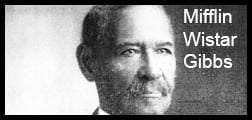
Mifflin Wistar Gibbs, one of the best known of the Black pioneers, was the first Black person to be elected in British Columbia and serve as a municipal councillor. He served as a councillor in Victoria from 1866 to 1869, representing the James Bay Ward. While on council, Gibbs chaired the Ways and Means Committee and from time-to-time acted as Deputy Mayor. Read more about his unprecedented achievements.
May 25, 1868: Governor Frederick Seymour proclaims Victoria as the capital of British Columbia
September 14,1868: The Yale Convention
On September 14,1868, 26 delegates from the BC colonies met at Yale, BC for a convention of the Confederation League. The Confederation League was led by Amor de Cosmos, then a B.C. legislative council member. Mifflin Gibbs, represented Salt Spring Island. The convention stimulated popular support for the union with Canada as a solution to the Colony of British Columbia’s financial problems. In 1970 BC commissioned a plaque commemorating the convention.
September 16, 1868: The Barkerville Fire
John Anderson, a local correspondent for “The Elevator” a San Francisco newspaper, wrote of the effects of the Barkerville fire, "Mr. Editor: —Since I last wrote you, we have met with a serious calamity— Barkerville has been entirely destroyed by fire, and it has been a ruinous loss to many…among the sufferers are our friends W.D. Moses, I.P. Gibbs, and Miss Hickman. Mrs. R. Gibbs saved her things, but lost her house”. The Black residents mentioned are William Delany Moses who owned and operated a barbershop, I.P. Gibbs is a brother of Mifflin Gibbs. R. Gibbs is Rebecca Gibbs, a sister-in-law of Mifflin Gibbs, and one of Canada’s first Black female poets. Her poem about this fire was published in the Cariboo Sentinel and later in The Elevator. Her story
Some Black pioneers return to the United States after the Civil War
Some Black pioneers did return to the U.S. to fight in the Civil War and after the Civil War. The abolition of slavery in the U.S. in 1865 made returning to their former homes seem more possible. Mifflin Gibbs returned to the U.S. late in 1869 (after the Yale Convention). In his biography he writes, “I had left politically ignoble; I was returning panoplied with the nobility of an American citizen.” The legal framework had changed with the adoption of three new amendments to the U.S. Constitution. The 13th Amendment, ratified on December 6, 1865, abolished slavery. The 14th Amendment, ratified on July 21, 1868, granted citizenship to any person born or naturalized in the U.S. The 15th Amendment, ratified on March 30, 1870, declared that the right to vote shall not be denied on account of race, colour, or previous condition of servitude.
July 20, 1871: British Columbia becomes the sixth province to join Confederation
By 1871, the federal government of Canada finally promised to build a railway to British Columbia. However the railway was not completed until 1885! By a United Kingdom Order in Council, British Columbia became the sixth province on July 20,1871. Sir Joseph Trutch was appointed the first Lieutenant Governor, and the Legislative Assembly elected John Foster McCreight as the first Premier. Trutch was known for his anti-Indigenous policies. In 2022 both Victoria and Vancouver renamed Trutch St. in consultation with the area Indigenous nations. [caption id="attachment_6009" align="aligncenter" width="1078"] Image courtesy of “Canada’s Government Throughout the Years”[/caption]
1871: Census for Blacks in B.C. and Canada
The total population of the province in 1871 was 36,427. That number included 8,576 (23.7%) British/Continental European, 1,548 (4.3%) Asian, and an estimated 25,661 (70.8%) Indigenous. Source: Jean Barman “The West Beyond the West”, pg. 429. The official census for the Government of Canada reported 462 “coloured” people in the province. In Victoria, an informal census by the Victoria Police Department counted 128 “coloured” men and 89 “coloured”
Deas Cannery employs 25 people
John Sullivan Deas took over the salmon canning business that had been started by Edward Stamp and pre-empted the land between Delta and Richmond that now bears his name. The British Colonist newspaper reported on July 25, 1872, “At the Fishery which is carried on by Mr. Deas some 300 cases of canned salmon were already put up, four boats were constantly at work, the number of men employed is about 25.” [caption id="attachment_6016" align="aligncenter" width="400"] The cannery was a substantial enterprise that included 3 buildings surrounded by a dyke, which enclosed about seven acres, together with smaller buildings, a wharf and sheds. At least one of the smaller buildings included a bunkhouse for living quarters. Image Courtesy of Royal BC Museum and Archives[/caption]
November 26, 1872: BC legislation is enacted for Black men to be on the official list of jurors
Although Peter Lester sat as a juror in February 1860, Black men were not on the “official list of jurors maintained by the Sheriff’s office” as had been promised by Governor Douglas. In March 1872, Black residents presented a petition to the Legislative Assembly requesting that their names be added to the official list. On March 21, 1872 the Daily British Colonist reported “The resolution was lost 5 to 13”. The article reported “Dr. Ash replied that a colored man had never been summoned on a jury in Victoria and the reason seemed to be that white men object to sitting beside colored men.” A resolution adding Black residents as jurors was finally passed in November 1872. Image A-01626 Courtesy of Royal BC Museum and Archives
John Craven Jones and Henry W. Robinson are elected to Salt Spring Island council
When the township of Salt Spring was incorporated in Spring 1873, John Craven Jones, the island school teacher, and Henry William Robinson, originally from Bermuda, were elected to the seven-member council. Robinson served as the council secretary. Salt Spring Island remained incorporated for about 10 years. Today the island is an unincorporated rural Electoral District within the Capital Regional District (CRD).
Pompey Jackson may be the oldest person buried at Ross Bay Cemetery
Pompey Jackson is thought to be the oldest person buried at Ross Bay Cemetery (Site No. G42 W18). On October 3,1873 the British Daily Colonist carried a brief notice of his death “Old Jackson, a colored man, aged 111 years, died near the Royal Oak yesterday (October 2, 1873). He was born in Virginia in 1762. His death in 1873, age 111 indicates that if he was one of the settlers who arrived in 1858 he would have been about 96 at that time. There is indication that Jackson had been farming almost to the end. A year before his death, the Colonist reported on the civil case of Pompey Jackson vs. C. King involving a dispute about the ownership of a cow.
September 1874: Emma Stark — 1st Black teacher on Vancouver Island
Emily Arabella (Emma) Stark was the daughter of Louis and Sylvia Stark. She was appointed the first teacher in the new North Cedar School in August 1874, becoming the first Black teacher on Vancouver Island. Emma grew up on Salt Spring Island, arriving with her parents, grandparents and 1 brother when she was just 4 years old. She completed high school in Nanaimo. Here's her story
Black and white community members meet to organize First Baptist church
In the initial stages of this church, Blacks and whites met in homes for prayer meetings. On May 3, 1876, 15 people, including Black pioneers Fielding and Julia Spotts, Thomas W. Pierre and Augustus Christopher, met to organize the First Baptist Church. This was the first Baptist cause to be inaugurated in British Columbia, and the first Canadian Baptist church west of Winnipeg. Today, the First Baptist Victoria church is located at the corner of North Park and Quadra Streets, Victoria. First Baptist Church History
Fielding Spotts serves as South Saanich school trustee from 1879 to 1884
Fielding and Julia Spotts were part of the first Black community that settled in Saanich, just north of Victoria. They had eight children. Fielding was a trustee at the schools their eight children attended; Lake District School circa 1870 and then at the South Saanich School circa 1879 to 1884. Their story Image courtesy of Royal BC Museum and Archives
June 25,1883: Grafton Tyler Brown art exhibition opens in Victoria
Grafton Tyler Brown is considered the first professional Black artist in the Pacific west. The one-week art exhibition, the first art exhibit in Victoria by any artist, included 22 paintings: views of Victoria, surrounding area and the mainland. This photograph was taken in his studio at the Occidental Hotel in Victoria. The painting on the easel is “Valley of the Similkameen (1883)” This is his story Royal B.C. Museum holds the greatest number of and most significant of Brown's Canadian works. In March 2018 the Museum and Friends of the BC Archives Society purchased “Giant's Castle Mountain: A.L. Fortune's Farm, Enderby B.C.”, dated October 6, 1882; and in Feb 2022 RBCM purchased “Entrance to the Harbour", Victoria B.C., May 1883, depicting Victoria’s harbour — “it was the signature painting in Brown’s 1883 exhibition.”
William Allen Jones is the 1st licensed dentist in BC
William Alan Jones was the first person to be granted a licence to practice dentistry (June 26,1886) under the British Columbia Dental Act. William received a degree at Oberlin College in 1857. He was the oldest of three brothers who came with the Black pioneers in 1858. After the American Civil War, he returned to Oberlin College to complete his dental studies and then returned to the gold rush town of Barkerville, where he had the nickname of “Painless Jones.” “Painless Jones: The Barkerville Dentist” Image is a pencil sketch by Gene Grooms, local artist (1994); BC Black History Awareness Society Collection
July 4, 1886: First scheduled passenger train to BC arrives at the Port Moody terminal
150 passengers arrived on board the train of an engine, tender, baggage car, express and mail car, two emigrant sleepers, one first-class, one Pullman, and one private car. Hogan’s Alley in Vancouver’s Strathcona neighbourhood became home to many Black porters employed by the railroad.